

Our coastline is changing. We need to act now to protect what we love so we can enjoy it in the future.
We have been working on a long-term plan to manage our coastline between Nobbys Headland and Glenrock Lagoon collectively known as our Southern Beaches. This Coastal Management Program will contain a series of actions to help us adapt and respond to both immediate and future changes on our coast.
Although we’re planning for all of our Southern Beaches, the 2025 phase of consultation focused on capturing your feedback on potential management options for our coastline from Bar Beach to Merewether.
We’re focused on this particular section of our coastline because our investigations have identified that this section coastline is at the highest and most immediate risk, which is why the proposed management options focused on this area. Due to the changing nature of our coastline, including the impacts of climate change, the status quo cannot remain. We need to act to ensure our community and visitors can continue to enjoy the coastline now and into the future.
Your input has helped us understand community views on the proposed management options for this high risk area.
What management strategies are we considering?
What management strategies are we considering?
We’re considering a range of management strategies for Bar Beach to Merewether, such as:
Beach nourishment is the placement of large volumes of sand to replace the sand that is lost as it moves along the coastline. The aim of beach nourishment can be to build coastal resilience by providing a protective buffer between the shoreline and nearby infrastructure with large amounts of sand. Alternatively, it can be done for amenity purposes to create a wider sandy beach for recreational purposes which offers limited protection to infrastructure.
While the sand is there, beach nourishment will ensure our beaches stay sandy for recreational purposes and provide more protection during erosion events. This option includes both mass nourishment, which involves one initial high-volume campaign and sand top-ups, where smaller amounts are placed at regular intervals to ensure sand volumes remain optimal.
The sand for beach nourishment could be sourced from offshore, or smaller volumes from Nobbys Beach, where sand accumulates and is unable to move further north due to the headland and Newcastle Harbour breakwaters. However, sourcing large volumes of sand can be difficult, and this option can have an impact on local surf breaks.
Beach nourishment could more easily be described as a establishing a bay, rather than a surf beach – noting that there would be severe impacts to the surf quality.
Protection structures such as seawalls and revetments are hard structures that are built to absorb the energy from waves and protect the land and infrastructure behind these structures.
Seawalls can be made from concrete, large rocks and rock bags, and run in parallel to the coastline or the land they're in place to protect. Protection structures can cause 'end effects' where erosion is pushed to the end of the wall, while the area in front of the structure is protected.
This option also effectively ‘fixes’ the coastline in place. As sea levels rise, this means the available beach width will decrease unless additional measures are considered. Over time, the protected area may resemble the foreshore along Shortland Esplanade at high tide, with the ocean eventually lapping directly against a hard wall.
This option may include the maintenance of existing or construction of new structures.
Managed retreat allows the shoreline to naturally recede. This option will generally require the strategic relocation of assets, such as buildings and roads, to enable the coastline to naturally migrate landward.
This option is environmentally friendly and sustainable in the long-term, although it may change the aesthetic of the beach depending on the underlying geology.
Managed retreat could more simply be described as a re-naturalisation of the beach by removing the man made built form.
Generally, the strategies above are not considered in isolation. Often a combination is required with protection, nourishment and retreat elements.
What combination of strategies are realistic?
What combination of strategies are realistic?
A summary of the positive and negative impacts of each short-listed management options is provided below.
Each of these options has different pros and cons, and all of them require trade-offs. The management options will be supported by activities like ongoing dune rehabilitation and cliff stabilisation works.
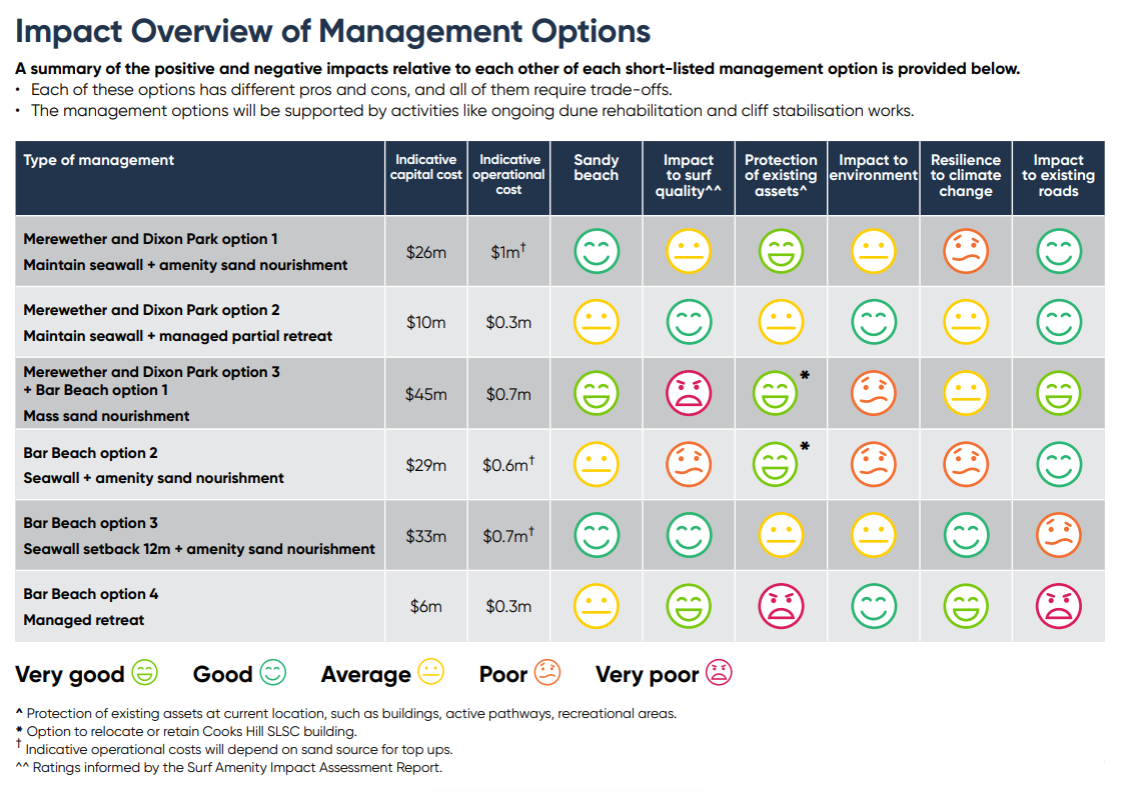
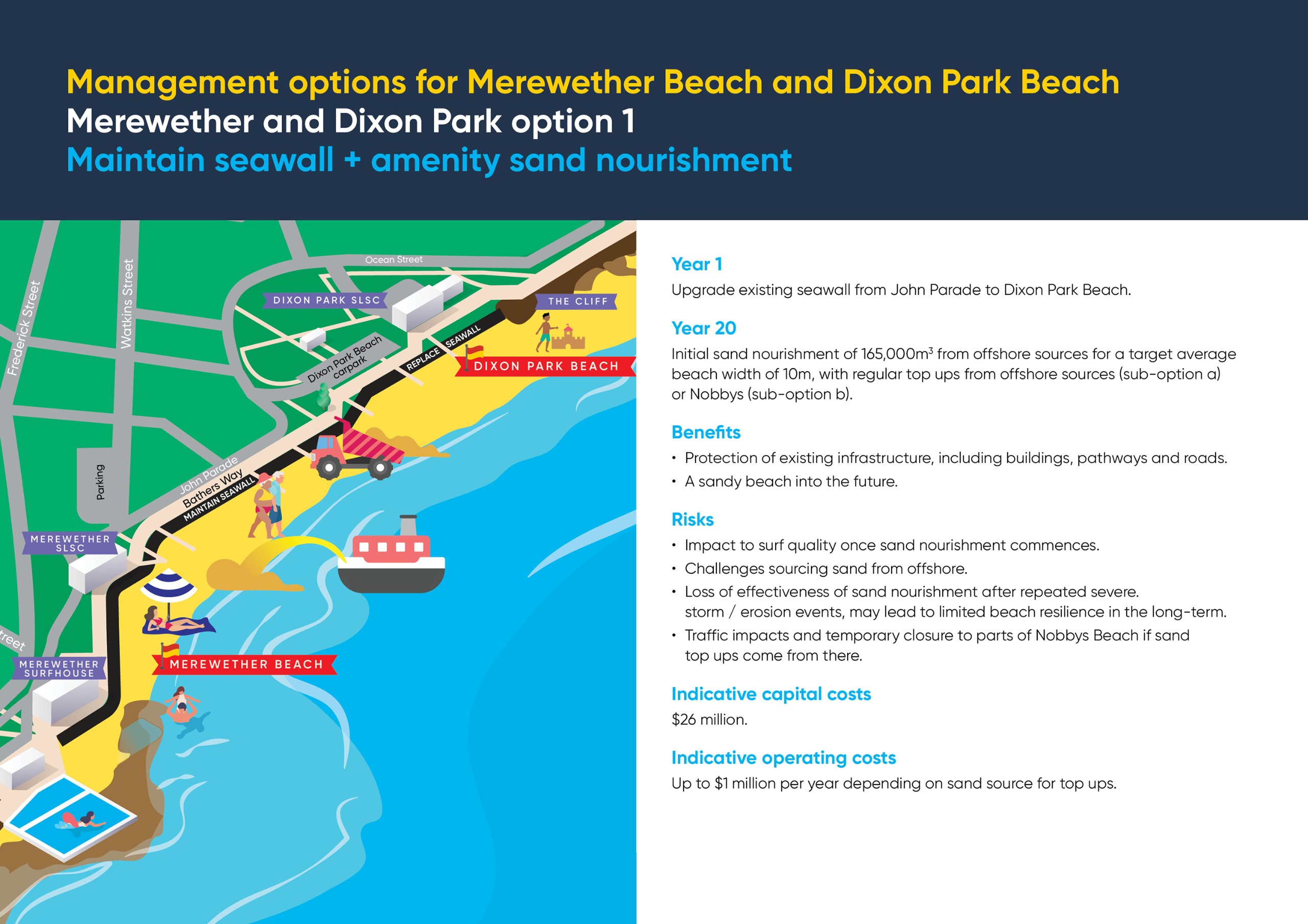
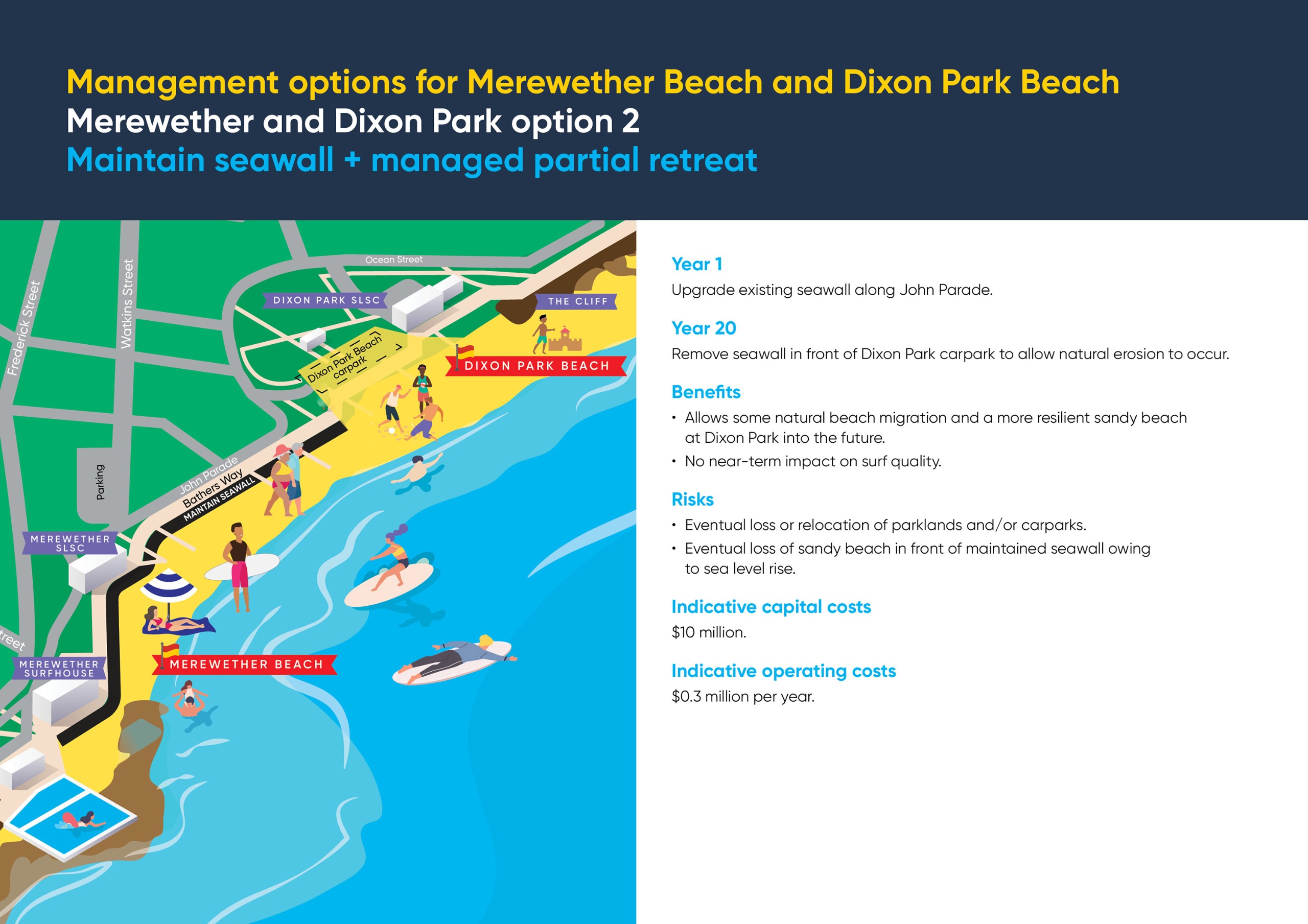
This is just a high-level overview, but we want you to feel fully informed. That’s why we’ve created the information tiles below, where you can dive deeper into the options being considered.
Image 1 of 7
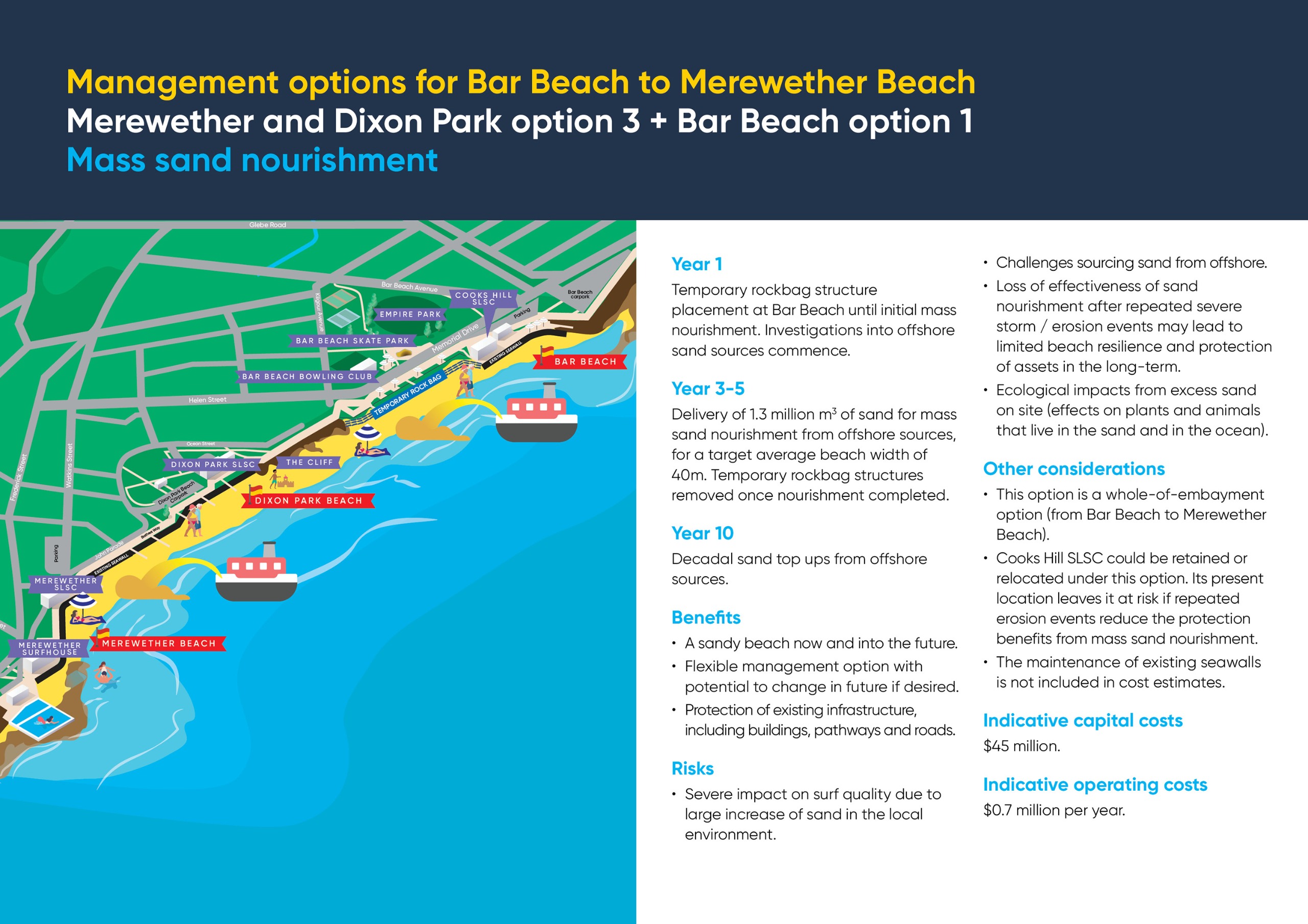
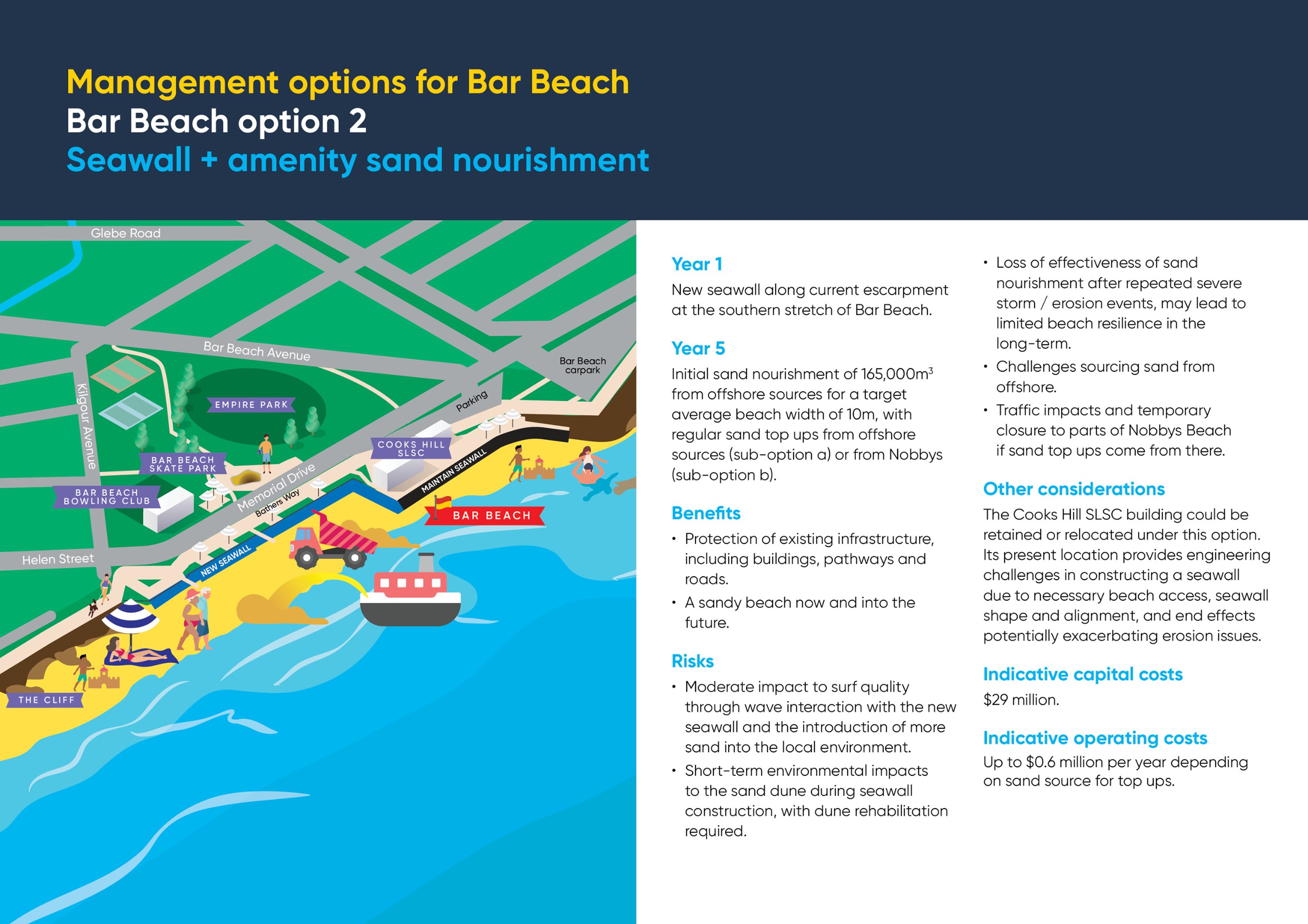
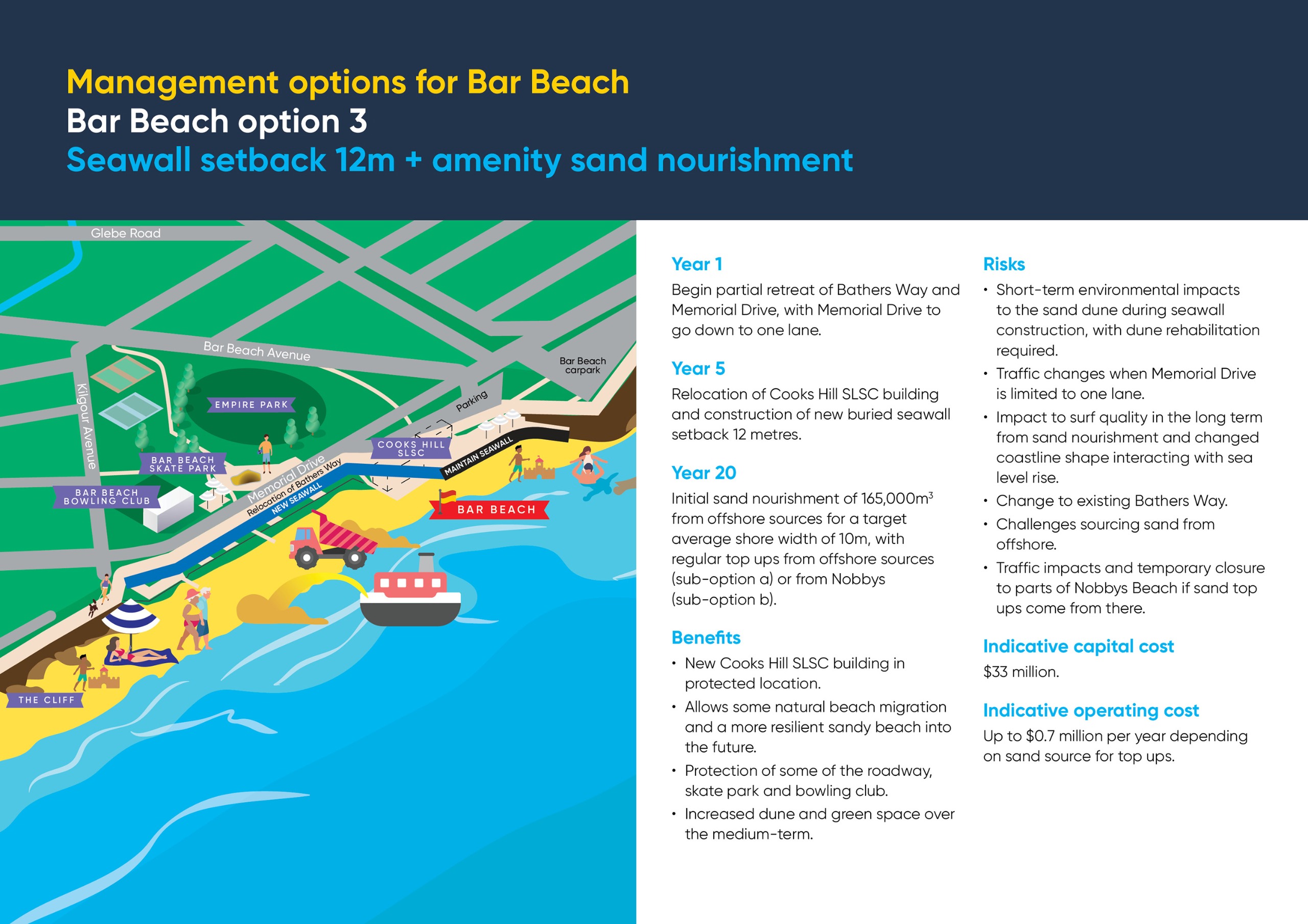
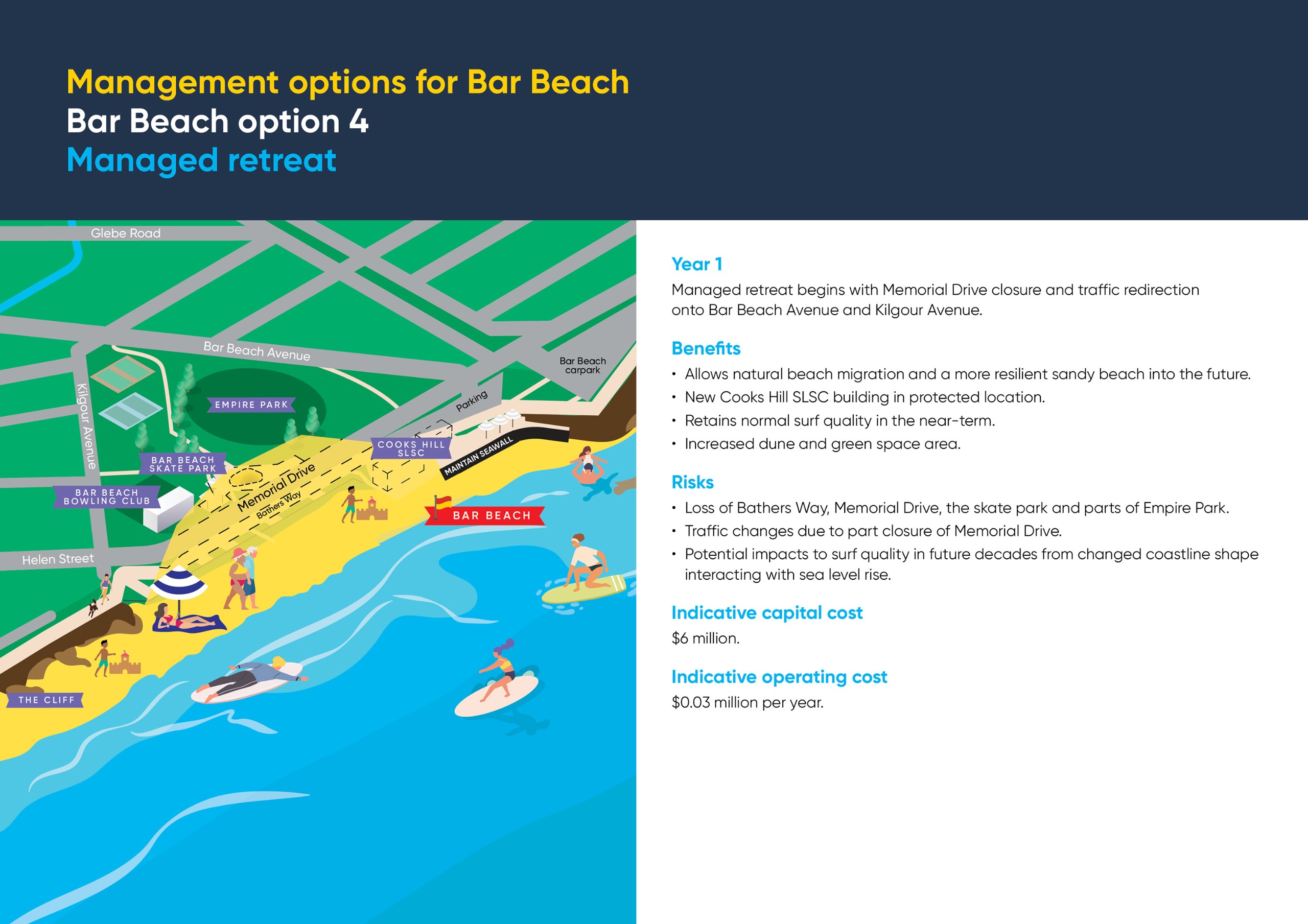
In 2025, we undertook community consultation to understand whether you support any of the proposed management options moving ahead, because doing nothing is no longer viable.
Why was it important for you to have your say?
Why was it important for you have your say?
Newcastle’s identity is closely tied to its coastline and beaches. With increasing pressures such as climate change and growing visitor numbers, protecting this identity while balancing community enjoyment and environmental care is more important than ever.
In the lead up to the broader community consultation (which is now closed), we shared information about coastal management strategies to give you the knowledge you need to provide informed feedback. Following this, we wanted to hear your views on the options being considered for the Bar Beach to Merewether stretch, so we can shape the future of our coastline together.
Your feedback is one of several tools being used to help determine which management options are included in the draft Coastal Management Program (CMP), which is currently being developed.
Thanks for having your say!
We love our coast, that's why we need to work together. Our CMP is being developed with your input to reflect shared values, ensure alignment with other initiatives, and foster collective action.
The Newcastle Southern Beaches CMP - Bar Beach to Merewether management options consultation report and engagement summary report are now available.
Between 28 September and 24 November 2025, we heard from 2,224 people across Newcastle through our online survey, face-to-face conversations at local events and our quick poll.
Your input help us understand which of the management strategies you prefer for the Bar Beach to Merewether stretch and why.
How you got involved
There were several ways you could have your say between 28 September and 24 November 2025:
- Visited us at pop-up events at events like the Spring Festival, Mayfield Day or Down the Park or seen us at various locations such as Bar Beach, Blackbutt Reserve, Dixon Park Beach, Bar Beach, Nobbys Beach and Merewether Beach.
- Had your say online via our online survey.